Typical Chromite Beneficiation Process Flow
The typical beneficiation process for chromite ore primarily includes stages such as crushing, grinding, washing and classification, gravity concentration, and flotation purification. The objective is to achieve effective liberation and separation of chromite minerals from gangue, ultimately obtaining a high-grade chromite concentrate product.
I. Crushing
The run-of-mine ore, which has large lump size, first undergoes crushing. Jaw crushers or cone crushers are typically used to reduce the ore to a particle size below 25 mm, providing suitably sized feed for the subsequent grinding operation.
II. Grinding
The crushed ore is fed into a ball mill for fine grinding. The purpose of grinding is to achieve sufficient liberation of chromite minerals from the gangue. The ore is generally ground to a specific fineness, often requiring over 80% of particles to pass 200 mesh (approximately 0.074 mm), to facilitate subsequent separation.
III. Washing and Classification
The ground ore slurry is sent to a spiral classifier for processing. The spiral classifier serves two main functions:
Washing and Desliming: Effectively removes fine slimes and clay impurities from the slurry, reducing their interference with the separation process.
Size Classification: Classifies the sand particles into different size fractions based on differences in settling rates. The size fraction meeting the requirements for the next stage proceeds to gravity separation, while the coarse sand that does not meet standards is returned to the mill for regrinding.
IV. Gravity Concentration
Gravity separation is the core stage of chromite beneficiation, utilizing differences in mineral density for separation. Commonly used equipment includes:
Jig Machine: Separates coarse and medium-grained chromite minerals through the action of a vertical alternating water flow, achieving initial concentration.
Shaking Table: Provides precise separation for fine-grained materials using mechanical shaking and water flow, yielding high-grade chromite concentrate and middlings. The combined use of jigs and shaking tables can cover a wider size range and improve recovery efficiency.
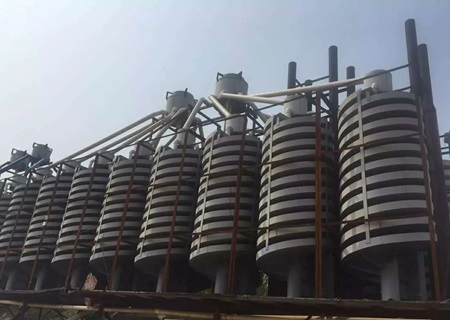
Spiral Chute: Primarily used for cleaning the rough concentrate or middlings obtained from gravity separation. Utilizing centrifugal force and water flow, it further upgrades the chromite concentrate grade while separating out tailings.
V. Flotation Purification (Optional)
For ores with fine dissemination or complex composition, or to further recover chromite from gravity separation tailings, the flotation process can be employed. The feed is conditioned in a flotation cell with reagents such as collectors and depressants, causing the target minerals to attach to air bubbles and float. The floated concentrate is skimmed off. This process helps improve the final concentrate grade and overall recovery rate.
The chromite beneficiation process achieves mineral liberation through crushing and grinding. After classification and desliming, gravity separation equipment accomplishes concentration, while flotation can serve as a supplementary method to further enhance separation efficiency. In actual production, processes should be flexibly selected and combined based on ore characteristics to achieve efficient recovery of chromium resources.
Categories
News
Contact Us
Contact: Jiangxi Victor International Mining Equipment
Tel: +86 15390744410
E-mail: sale06@miningshakingtable.com
Add: Guzhang industrial park, Shicheng, Ganzhou, Jiangxi, China