Fluorite Ore Gravity Separation Process and Key Equipment Introduction
In the beneficiation of fluorite ore, the gravity separation method has become the mainstream technique due to its low cost, high efficiency, and environmental friendliness. This article briefly introduces the main equipment and process flow for the gravity separation of fluorite ore, helping you understand the journey from raw ore to concentrate.
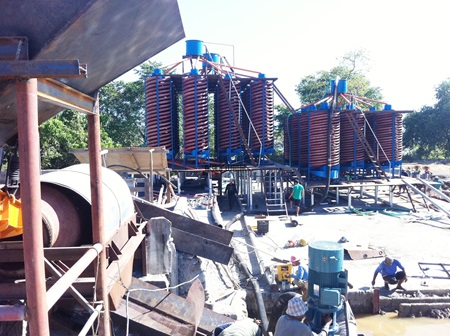
I. Vibrating Feeder
First, the raw ore is uniformly and continuously fed into a jaw crusher for primary crushing by a vibrating feeder.
II. Jaw Crusher
The primary task of the jaw crusher is to break the raw ore of varying sizes into particles of 20-50mm, laying the foundation for the subsequent fine crushing stage.
III. Hammer Crusher
Subsequently, the initially crushed fluorite ore is conveyed to a hammer crusher for secondary crushing. This stage is crucial, aiming to further reduce the ore's particle size, ensuring that 60% to 90% of the material reaches a fineness of<3-5mm. This adequate crushing is a prerequisite for the subsequent gravity separation, as effective separation based on specific gravity differences only occurs after the fluorite is liberated from the gangue minerals.
IV. Jig Machine
After these two crushing stages, the material is sent to the jig for gravity separation. Under the action of pulsating water flow, the higher-density fluorite minerals separate from the lower-density gangue minerals, achieving efficient separation and concentration, and ultimately yielding a high-grade fluorite concentrate.
The vibrating feeder, jaw crusher, hammer crusher, and jig machine together form an efficient production line for the gravity separation of fluorite ore. Selecting the appropriate gravity separation equipment is key to improving fluorite recovery rates.
Categories
News
Contact Us
Contact: Jiangxi Victor International Mining Equipment
Tel: +86 15390744410
E-mail: sale06@miningshakingtable.com
Add: Guzhang industrial park, Shicheng, Ganzhou, Jiangxi, China