Monazite Beneficiation Process Flow from Coastal Sands
Monazite contained in coastal sands is an important rare earth mineral resource. How can monazite be efficiently separated from coastal sands? This article will briefly introduce the beneficiation process flow for monazite.
I. Overview of the Monazite Beneficiation Process Flow from Coastal Sands
The core of separating monazite from coastal sands lies in using physical methods to separate the target mineral from impurities. The process mainly includes stages such as raw ore screening, chute gravity separation, magnetic separation, and tailings concentration via shaking table. Through the scientific combination of equipment and processes, efficient recovery of monazite can be achieved while also considering environmental protection and comprehensive resource utilization.
II. Monazite Beneficiation Process Flow
1. Raw Ore Crushing and Screening
First, the collected coastal sand raw ore is screened using a vibrating screen to facilitate subsequent gravity separation. The screened sand particles then proceed to spiral chutes for gravity separation.
2. Chute Gravity Separation (Roughing Stage)
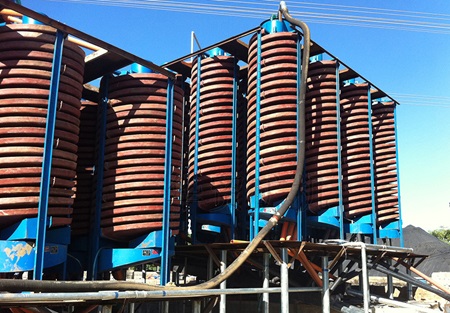
The screened sand undergoes gravity separation in spiral chutes. Utilizing the principle of gravity separation, the chutes achieve stratification based on the specific gravity differences of minerals under the action of water flow on an inclined surface: heavier minerals like monazite settle to the bottom and are collected as rough concentrate by the spiral chutes; lighter impurities such as silt are carried away by the water flow and discharged as tailings. This step preliminarily concentrates the monazite and reduces the load for subsequent processing.
3. Tailings Concentration by Shaking Table
The tailings generated from chute gravity separation and magnetic separation are not entirely discarded but are further concentrated using a shaking table. The shaking table utilizes differences in mineral specific gravity and the action of lateral water flow for precise stratification: minerals of different sizes and specific gravities form a fan-shaped distribution on the table deck, with useful minerals like monazite concentrated in specific areas for recovery. This step significantly improves resource recovery rates and reduces waste.
4. Dewatering and Drying
The final obtained monazite rough concentrate requires drying treatment using equipment like dewatering screens and drying machines. The dewatered rough concentrate needs further magnetic separation purification to obtain a higher-grade monazite concentrate.
5. Magnetic Separation (Concentrate Purification)
The rough concentrate enters a three-disc belt magnetic separator for magnetic separation. Monazite is typically non-magnetic, whereas associated magnetic minerals like magnetite and ilmenite are adsorbed by the magnetic separator, thus achieving separation from monazite. The non-magnetic portion after magnetic separation is the monazite concentrate, and the magnetic minerals can be recovered as by-products, enhancing comprehensive resource utilization.
The process flow for separating monazite from coastal sands can be summarized into three main processes: screening, gravity separation, and magnetic separation.
Categories
News
Contact Us
Contact: Jiangxi Victor International Mining Equipment
Tel: +86 15390744410
E-mail: sale06@miningshakingtable.com
Add: Guzhang industrial park, Shicheng, Ganzhou, Jiangxi, China